

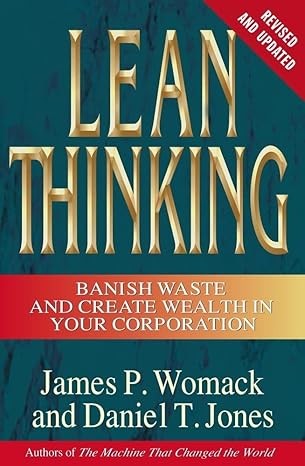
by James P. Womack (Author), Daniel T. Jones (Author)
Lean Thinking: Transforming Business for the Twenty-First Century
Expanded, updated, and more relevant than ever, Lean Thinking is a
bestselling business classic by two internationally renowned management analysts.
The book describes a modern business system that surpasses the mass production
model of Ford, the financial control system of Sloan, and the strategic system
of Welch and GE. It is based on the Toyota lean model, combining operational
excellence with value-based strategies to achieve steady growth under diverse
economic conditions.
Steady Growth Through Lean Principles
Unlike companies celebrated by 1990s business gurus that often suffered
crash-and-burn failures, the firms profiled in Lean Thinking—from
small Lantech to midsized Wiremold, niche Porsche, and giant Pratt & Whitney—
have steadily grown, largely unnoticed, even amid market turbulence. Toyota,
the leader in lean thinking, continues to pursue global leadership in the
automotive industry.
Going Back to Basics
Lean thinkers focus on what customers truly perceive as value, which often
differs from existing organizational assumptions. They then align value-creating
activities along a value stream while eliminating non-value-adding activities,
which usually make up the majority.
By creating flow, products and designs advance smoothly and rapidly at the
pull of the customer rather than the push of the producer. As flow and pull
are implemented, lean thinkers accelerate the cycle of continuous improvement
in pursuit of perfection. The book brings these concepts to life with striking
real-world examples.
A Step-by-Step Action Plan
Lean Thinking offers guidance for managers seeking to implement lean
principles in their organizations. Part II provides a detailed action plan
based on studies of more than fifty lean companies across various industries
worldwide.
Even experienced lean practitioners will find Part III compelling. It introduces
the concept of the extended lean enterprise, linking value-creating activities
from raw materials to the customer for each product family. This allows firms
to take a dramatic leap forward in efficiency and effectiveness.
Keeping Lean Relevant
Part IV, an epilogue to the original edition, updates the story of lean thinking
with an enhanced action plan informed by the experiences of lean firms since
the book’s original publication.
Lean Thinking is not a quick-fix management program. It is a philosophy
of thinking, being, and doing for serious long-term managers. By applying these
principles, organizations can achieve sustainable improvement and global impact.